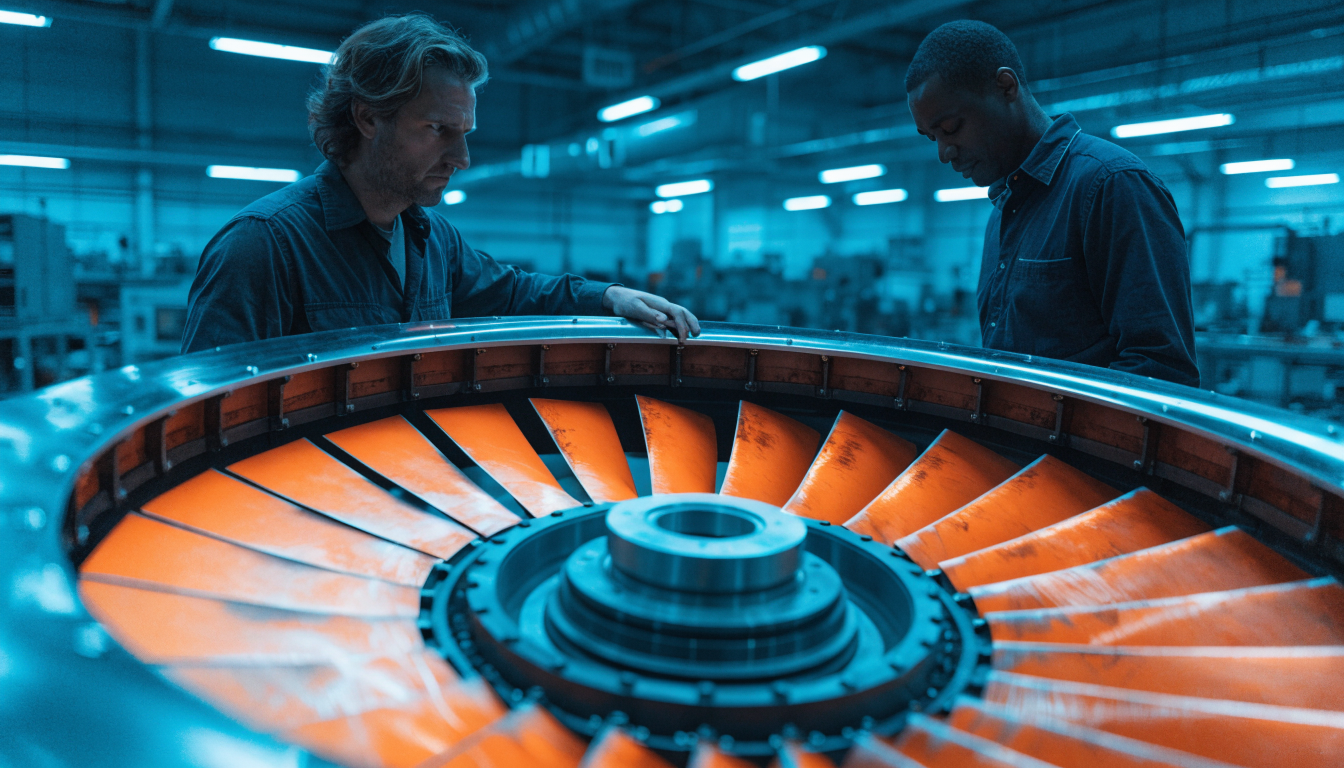
Your car engine is quietly getting smarter. Engineers are combining cutting-edge thermal management with artificial intelligence to make engines last longer, run cleaner, and fail less often. This isn't speculation — it's happening in production vehicles right now.
Here's what's driving it, why it matters, and how you can engage with these ideas directly — whether you're an engineering student, a curious driver, or a professional who wants to stay current.
Key Takeaways
- Most engine failures trace back to uncontrolled heat — microscopic fatigue and material degradation compound across thousands of combustion cycles
- Zonal cooling systems independently regulate coolant flow to different engine regions, improving thermal efficiency by 2–4% and doubling seal service life in some applications
- Thermal barrier coatings borrowed from aerospace reduce heat rejection into engine metal by 15–25%, keeping energy in the working gas where it produces power
- AI predictive models trained on millions of engine cycles detect developing faults — injector fouling, bearing wear, hot spots — days or weeks before driver-noticeable symptoms appear
- Predictive maintenance cuts unnecessary service interventions by 20–40% and catches incipient failures before they cascade into catastrophic damage
- A thermodynamics equation solver online lets learners test real thermal scenarios in seconds, accelerating physical intuition far beyond what hand calculation allows
Why Engines Fail — And Why Heat Is the Culprit
Most engine problems trace back to one thing: heat you can't control.
Combustion generates peak cylinder pressures exceeding 150 bar and temperatures approaching 2,500 K — thermal loads that push materials science to its limits. When those loads exceed what materials can handle, even briefly, microscopic fatigue initiates at the crystal lattice level. Over thousands of combustion cycles, that damage compounds. Seals degrade through elastomer chain scission, metal develops transgranular fatigue cracks, and oil films break down through oxidative shear — losing 30–50% of viscosity before scheduled change intervals.
Traditional Engine Design: Why Safety Margins Weren't Enough
For decades, engineers managed heat reactively. They designed for worst-case temperatures, added generous safety margins (typically 20–35% above peak loads), and relied on over-specification. It worked, but it was thermodynamically wasteful. Engines were heavier, ran cooler than optimal — lowering Brake Mean Effective Pressure by 8–12% — and still experienced wear rates that capped economic service life at 150,000–200,000 miles for many platforms.
That era is ending.
What Thermal Advances in Engine Design Actually Mean
Thermal advances mean smarter, more precise heat routing — away from where it damages, toward where it produces work. In practice, this means transitioning from fixed cooling architectures to dynamic, load-responsive systems.
Zonal Cooling and Adaptive Thermal Management
Modern engines use zonal cooling: independently controlled coolant flow to different engine regions via electronically actuated thermostats and flow restrictors. The cylinder head might run at 95–100°C while cylinder walls hold at 85–90°C — minimising piston ring wear while keeping combustion chamber temperatures high enough for complete combustion and NOx reduction. Industry data shows zonal cooling improves thermal efficiency by 2–4% and reduces localised hot-spot temperatures by 30–50 K. That temperature difference is the gap between a 100,000-mile seal life and 200,000 miles.
Thermal Barrier Coatings and Materials Science
Thermal barrier coatings (TBCs) — yttria-stabilised zirconia systems originally developed for jet turbine blades operating above 1,400°C — are now reaching automotive pistons and combustion chamber walls. As Automotive News reports, engineers are now applying these aerospace-derived techniques directly to extend car engine working life — a meaningful shift made viable by a 15–25% drop in ceramic coating deposition costs over five years.
These coatings deliver thermal conductivity as low as 1.2 W/m·K — roughly 100 times lower than bare aluminium — reducing steady-state heat rejection into engine metal by 15–25%. Higher in-cylinder temperatures drive more complete combustion, cutting unburned hydrocarbon emissions by 8–12%. Lower metal temperatures simultaneously reduce fatigue initiation risk: fatigue strength roughly doubles for every 30–40 K reduction in operating temperature.
Enter AI: Predictive Performance Modelling for Engine Longevity
Thermal advances alone are impressive. Pair them with AI, and the real transformation begins.
Predictive performance modelling uses machine learning algorithms — typically deep recurrent neural networks or gradient boosting models trained on 10+ million engine operating cycles — to anticipate how an engine will behave before problems occur. Think continuous condition-based diagnostics, not a periodic check-up.
How Predictive AI Works in Real-Time Engine Monitoring
Sensors throughout the engine — thermocouples in the piston crown, pressure transducers in the combustion chamber, acoustic knock sensors, crankshaft accelerometers — collect 5,000–50,000 data points per second. AI models trained on millions of cycles across varying fuel qualities, ambient temperatures, and degradation states interpret this stream in real time, establishing a healthy baseline and flagging deviations within minutes.
The system can identify the early signature of a failing injector (a characteristic pressure rise rate deviation 3–5 cycles before misfire detection), a developing hot spot (localised thermocouple drift of 5–8 K preceding failure by weeks), or abnormal knock patterns — all before any driver notices rough idle or power loss.
Why Predictive Modelling Changes Everything
Traditional maintenance schedules follow fixed intervals built on worst-case lab testing. Predictive modelling inverts this entirely. The system monitors actual conditions: oil viscosity via pump current draw, coolant condition via electrical conductivity, bearing wear via ferrous particle concentration, injector spray pattern via combustion pressure signatures. You service the engine when it needs it. That eliminates 20–40% of unnecessary maintenance interventions and catches incipient failures before they cascade into catastrophic damage.
The U.S. Department of Energy's Vehicle Technologies Office estimates that reducing engine friction by 10% and thermal losses by 5–8% through optimised cooling and combustion management delivers 5–7% fleet-wide fuel economy improvement — and predictive AI targeting exactly those loss mechanisms represents one of the most economically viable paths forward for internal combustion engines in hybrid architectures.
The Physics Behind It All
The principles driving these advances aren't mysterious. They're grounded in thermodynamics you can study, simulate, and understand.
The core equations — Fourier's heat conduction law (q = −k∇T), Nusselt number correlations governing convective heat transfer, the Carnot efficiency limit (η = 1 − T_cold/T_hot), and entropy generation minimisation — describe precisely why engines behave as they do under thermal stress. Typical petrol engines achieve brake thermal efficiencies of 30–35%, meaning 65–70% of combustion energy becomes waste heat. Understanding where that heat goes — and why — cascades directly into decisions about where to insulate, where to cool aggressively, and where to run hotter.
Using a Thermodynamics Equation Solver Online to Accelerate Learning
Manually solving coupled differential equations for transient heat conduction in a piston — a three-dimensional problem with moving boundaries — can take 30–60 minutes per iteration by hand. A good thermodynamics equation solver online lets you input real parameters (combustion temperatures of 2,000–2,500 K, coolant flow rates of 30–80 litres per minute, piston surface area in contact with combustion gases) and see heat flux magnitudes, transient temperature gradients, and time-to-steady-state within seconds.
This isn't about skipping the learning — it's about accelerating it. You test a hypothesis ("What if I insulate the cylinder crown by 0.5 mm?"), observe the consequence immediately, and build physical intuition for how thermal variables couple and compete. To ground this in mechanical reality first, the car engine mechanics guide walks through what actually happens inside the cylinder during each stroke — a useful foundation before modelling thermal scenarios numerically.
How Engineers Are Applying This Right Now
This isn't speculative. The Automotive News report confirms production engineering at major OEMs is already here. Several manufacturers deploy adaptive thermal management systems adjusting coolant flow, fan speed, and spark timing in real time based on load, driving conditions, and ambient temperature — responding to sensor feedback every 100–200 milliseconds. These systems have demonstrated 3–6% fuel economy improvements in EPA testing and extended service intervals by 25–40%.
Thermal Modelling in Hybrid Powertrains
Thermal modelling is arguably more critical in hybrid powertrains. A combustion event generates 15–20 kW of waste heat into the coolant system; an electric motor driving the same load produces distributed losses with no exhaust gas to scavenge from. Getting that balance wrong degrades battery temperature uniformity (causing capacity loss and accelerated cycle ageing) and simultaneously reduces combustion efficiency by running the engine cooler than thermodynamically optimal.
AI models trained on hybrid-specific thermal data — incorporating battery state-of-charge, motor speed, regenerative braking events, and predicted driving patterns from GPS — help engineers design multi-zone cooling architectures that would have been impossible to optimise manually with traditional steady-state tools.
From Aerospace to Automotive
Many of the most sophisticated computational fluid dynamics and thermal modelling techniques now entering automotive engineering were refined in aerospace first. Jet engines — operating at 40,000+ RPM with turbine blade surface temperatures near 1,300 K — pushed thermal simulation to its limits decades before automotive engineers needed these tools. Explore jet engine simulation methods to see conjugate heat transfer analysis and large-eddy simulation combustion modelling in their most advanced form, then trace how those techniques scale down from 70+ MW aerospace applications to 50–100 kW automotive engines.
What This Means for Learners and Educators
This wave of thermal-AI integration makes thermodynamics immediately tangible. Students aren't solving abstract rod-conduction problems from a textbook — they're engaging with real decisions affecting millions of vehicles: why does a 0.3 mm ceramic coating extend engine life? What sensor signals predict injector fouling? How does a machine learning model distinguish normal cycle-to-cycle combustion variation from incipient knock?
Practical ways to engage:
- Run scenarios with a thermodynamics equation solver online — model how insulating a combustion surface changes heat rejection magnitude and shifts thermal stress through the piston crown
- Follow Automotive News and SAE International technical papers to trace the path from fundamental research to production implementation, often a 5–10 year journey
- Browse all engine simulators to find interactive tools that match your level, and use them to visualise how changing combustion temperature affects efficiency, power output, and material fatigue risk simultaneously
The gap between classroom thermodynamics and real engineering has never been smaller.
Frequently Asked Questions
Q: What is thermal barrier coating and why are engineers applying it to car engines?
A: A thermal barrier coating (TBC) is a ceramic layer — typically yttria-stabilised zirconia — applied to combustion-facing surfaces such as piston crowns and cylinder head walls. It insulates metal components from peak combustion temperatures, reducing heat rejection into the engine structure by 15–25% and keeping thermal energy in the working gas where it produces power. Lower metal temperatures dramatically reduce fatigue initiation risk, extending component service life.
Q: How does AI predict engine failures before they happen?
A: AI models — usually deep recurrent neural networks or gradient boosting algorithms — are trained on tens of millions of engine operating cycles spanning different fuels, temperatures, and degradation states. Embedded sensors feed thousands of data points per second into these models, which establish a healthy baseline signature and detect statistical deviations. A failing injector, developing hot spot, or worn bearing each produces a characteristic signature the system can flag days or weeks before a driver notices any symptom.
Q: What is zonal cooling and how does it extend engine life?
A: Zonal cooling uses electronically actuated thermostats and flow restrictors to control coolant flow independently to different engine regions rather than treating the entire engine as a single thermal mass. The cylinder head might run hotter to aid combustion efficiency while the cylinder walls run cooler to reduce piston ring wear. Industry data shows this approach improves thermal efficiency by 2–4% and can double seal service life by reducing localised hot-spot temperatures by 30–50 K.
Q: How does a thermodynamics equation solver online help engineering students learn faster?
A: Solving transient heat conduction equations for a piston by hand — a three-dimensional problem with moving boundaries — can take 30–60 minutes per iteration. An online solver lets students input real parameters and see outputs in seconds, freeing cognitive bandwidth for hypothesis testing: "What happens if coolant temperature rises 10°C?" or "How does a thicker coating shift the thermal gradient?" That rapid feedback loop builds physical intuition far faster than algebraic hand-calculation.
Q: Why is thermal management more complex in hybrid vehicles than in conventional engines?
A: Hybrid powertrains manage two simultaneous waste-heat sources — combustion (generating 15–20 kW into the coolant) and the electric motor — with fundamentally different thermal profiles. A combustion event produces exhaust gas that can be used to scavenge heat; an electric motor driving the same load produces distributed resistive losses with no equivalent recovery pathway. Getting the balance wrong degrades battery temperature uniformity, accelerates cell ageing, and reduces combustion efficiency simultaneously. AI models that incorporate battery state-of-charge, motor speed, and predicted driving patterns are essential for optimising these multi-zone thermal architectures.
Q: What thermodynamics principles underpin the engineering decisions described in this article?
A: The key governing principles are Fourier's law of heat conduction (q = −k∇T), convective heat transfer described by Nusselt number correlations, the Carnot efficiency limit (η = 1 − T_cold/T_hot), and entropy generation minimisation. These equations explain why engines lose 65–70% of combustion energy as waste heat, where that heat flows within the engine structure, and which design interventions — insulation, zonal cooling, higher operating temperatures — most effectively recover usable work from that energy.
Q: How have aerospace thermal simulation techniques influenced automotive engine development?
A: Jet engines — with turbine blade temperatures near 1,300 K and continuous operation at extreme thermal loads — drove the development of conjugate heat transfer analysis, large-eddy simulation of combustion mixing, and high-fidelity thermal barrier coating deposition methods decades before automotive engineers needed them. As coating costs fell 15–25% and computational tools became accessible, automotive engineers adapted these methods for 50–100 kW car engines. The physics is the same; the scale and cost constraints are different.
The Road Ahead — and Where to Start
Engines that self-monitor via embedded sensor networks, adapt thermal management in real time, and flag maintenance needs before damage occurs could realistically double service life from 200,000 miles to 300,000+ miles in some applications — with meaningful reductions in manufacturing resource consumption and lifetime emissions per mile driven.
The engineers making that happen work at the intersection of materials science, fluid dynamics, machine learning, and classical thermodynamics. Understanding even the basics of that intersection puts you ahead — whether you're designing systems, teaching the next generation, or making better decisions about the vehicle you drive.
You don't need a lab or a research budget. A thermodynamics equation solver online, a quality simulation platform, and a genuine willingness to ask why is enough to start building real understanding. Browse all engine simulators on HowEnginesWork.com and start developing hands-on intuition for how thermal systems actually behave. The same foundational principles driving this engineering revolution are available to you right now.